


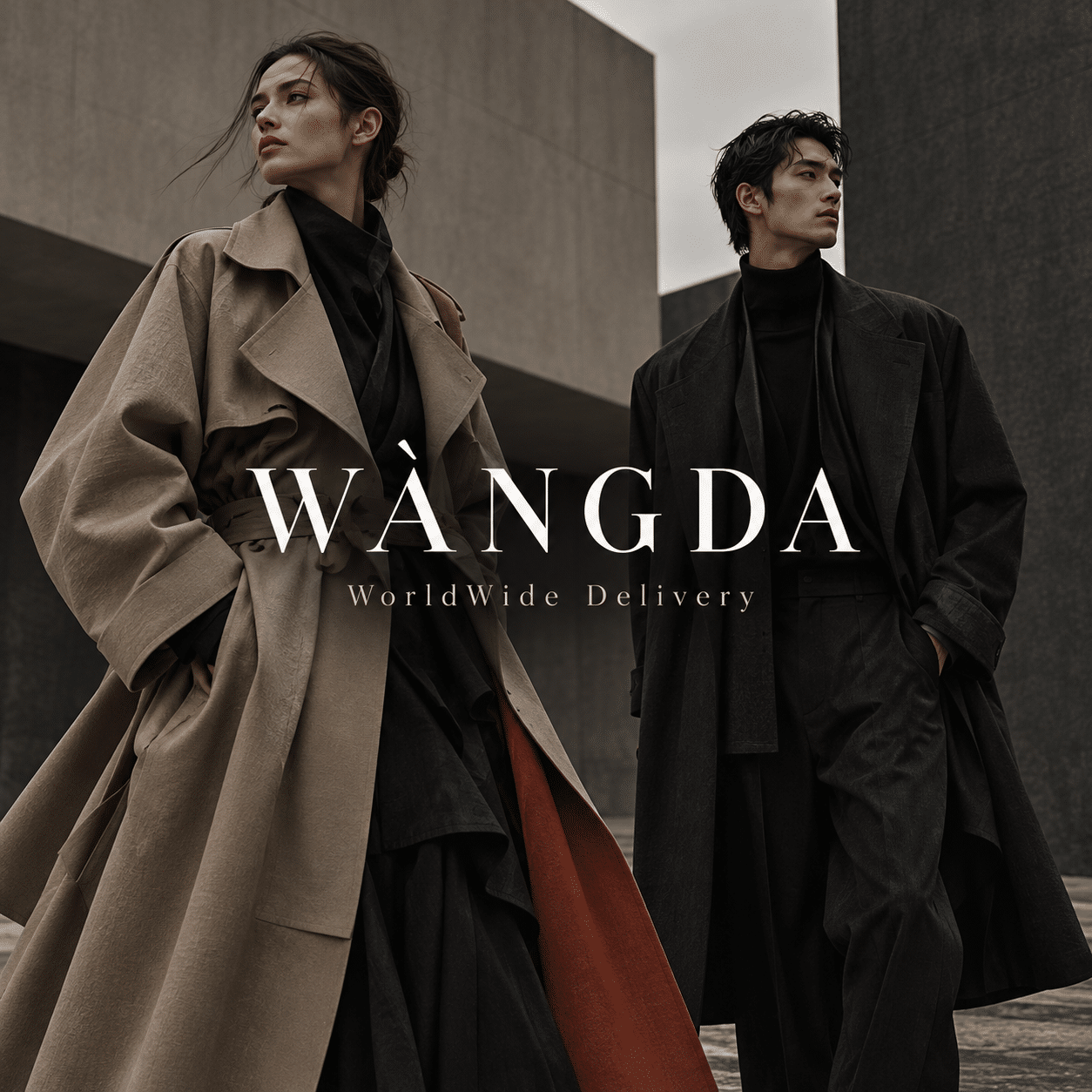
WANGDA’s storefront presents the label as a minimalist fashion brand, with clean lines, tailored forms and what it describes as Eastern craftsmanship at the center of its design language. Rather than centering its site on a single signature item, Wangda offers a broad clothing assortment, including coats, jackets, shirts, trousers, denim and knitwear. The catalogue and collection imagery provide the clearest picture of how the brand’s stated aesthetic is expressed across different types of clothing.
The range is especially visible through the men’s collection and outerwear pages, where individual garments are named and listed with prices. The homepage also identifies the brand with menswear and womenswear, though the supplied collection details focus on men’s styles. That distinction matters: the site establishes a wider brand identity, while the available product listings offer a more specific view of the menswear selection.
A design identity built around restraint
WANGDA describes its clothing through terms such as minimalist silhouettes, clean lines, precision tailoring and timeless elegance. These are the brand’s own descriptions, rather than independent assessments of construction or longevity. Still, the assortment gives those phrases some context. It includes recognizable wardrobe forms—wool coats, blazers, denim jackets, shirts and pleated trousers—alongside more distinctive names such as the Dark-knight Oversized Coat, Sateen Asymmetric Shirt and White Shadow-Stripe Hoodie Shirt.
That mix suggests a catalogue balancing familiar garment categories with details or proportions signaled in the product names. “Oversized,” “asymmetric,” “pleated” and “shadow-stripe” point to differences in silhouette or visual treatment, although the available pages do not provide enough construction information to explain those details further. The assortment therefore invites comparison at the level of form and category, without supporting assumptions about exact fabric weight, fit, finishing or how a garment behaves when worn.
The brand’s reference to Eastern craftsmanship is part of its stated positioning, but the supplied material does not identify specific techniques, production locations or makers. It is best understood as a broad element of WANGDA’s description, not as evidence for a particular process. For a shopper assessing the collection, the product names and listed categories are more concrete points of reference than the broader language of craftsmanship.
Outerwear anchors the visible selection
Outerwear is one of the most clearly presented parts of the men’s assortment. The dedicated page lists the Grey Essentia Wool Coat and Black Essentia Wool Coat, each shown at $745, as well as the Dark-knight Oversized Coat at $1,050. Jackets and tailored layers include the Beige Sport Harrington Jacket and Black Sport Harrington Jacket, both displayed with a $365 price and a second, higher price of $395; the page does not explain the relationship between those figures. The Elemento Blazer is listed at $525, and the Indigo Denim Jacket at $483.
The range shows several approaches to a top layer within the same collection: wool coats, a sport Harrington style, a denim jacket and a blazer. The names provide a modest but useful way to distinguish them, while the prices give a visible sense of the assortment’s spread. The pages do not specify garment measurements, wool composition, denim weight, lining, closures or care instructions in the supplied text, so those practical details cannot be inferred from the listings alone.
There is also a difference between the products displayed in the men’s outerwear catalogue and the looks promoted on the homepage. The homepage names a Rope Coat in Fur, a Layered Trench Coat and a Goose Down Padded Blazer among its FW26 looks, and notes that pre-order is available for the FW 26 collection. These names indicate a seasonal presentation that reaches beyond the items shown on the outerwear listing. They do not, by themselves, establish material specifications or availability for any particular size or item.
For readers browsing the brand, the distinction between collection imagery and a catalogue listing is useful. The homepage’s look references communicate the range of ideas WANGDA is showcasing, while the collection pages identify specific products and displayed prices. Because the supplied content does not give detailed product descriptions for those seasonal looks, it would be premature to treat their names as complete specifications.
More than coats: shirts, trousers and denim
The men’s collection extends beyond outerwear into pieces that can be considered as components of a wider wardrobe. Listed shirts include the Sateen Asymmetric Shirt at $215, the White Shadow-Stripe Hoodie Shirt at $150 and the Black Hoodie Shirt at $150. The page also shows trousers such as Camel Pleated Trousers at $225, Gray Pleated Trousers at $225 and Brown Classic Cropped Trousers at $185, with a second price of $215 displayed for the latter. These names indicate variation in color and silhouette, but not the exact cut, fabric content or styling details.
Denim appears in more than one form: the Indigo Denim Jacket is listed at $483, while Indigo Harringbone Jeans are shown at $325. The spelling in the product listing is “Harringbone”; the available source does not provide further information about the jeans’ construction. Taken together, the denim pieces sit alongside more tailored options rather than forming a separate, highly detailed denim range in the supplied material.
Other names broaden the selection further. The men’s collection page includes a Grey Oversized Cashmere Turtleneck at $315, Napoleon Jacket at $300 and Brown Classic Cropped Trousers. It also lists a White Shadow-Stripe Hoodie Shirt, a Black Hoodie Shirt and a White Shadow-Stripe Hoodie Shirt more than once in the page text. That repetition appears in the collected listing and should not be read as evidence of separate product versions. Overall, the selection gives shoppers several garment categories to browse, but the page does not include enough detail to compare construction or fit across them.
How to read the catalogue
WANGDA’s collection page provides basic navigation tools that help visitors orient themselves within the assortment. The listed categories include shirts, coats and jackets, trousers, jeans, suits, hoodies and other clothing types. Size filters run from XS through XL, and the interface includes an in-stock-only option. These are features of the website’s browsing interface; the supplied pages do not confirm which sizes are available for each specific item or whether every listed product is currently in stock.
Prices also offer a useful, limited comparison point. In the visible men’s listings, examples range from $150 for the hoodie shirts to $1,050 for the Dark-knight Oversized Coat. Other listed items fall between those figures, including trousers, shirts, a cashmere turtleneck, a blazer and several jackets. This is a snapshot of displayed prices, not a complete pricing policy or a guarantee that prices will remain unchanged. The source includes some products with two price figures, but does not explain whether those represent a markdown, a previous price or another distinction.
For a considered comparison, visitors would need to consult each product’s own page for information not shown in the collection text: precise measurements, fabric composition, garment care, construction details and current size availability. The pages supplied here do not answer those questions. The collection overview is most useful as a map of the available product names, categories and displayed prices, rather than as a substitute for item-level specifications.
A brand view shaped by both catalogue and image
The homepage gives WANGDA a visual and seasonal frame, while the collection pages make the everyday breadth of the assortment easier to see. Homepage references include FW26 looks and a note that pre-order is available for the collection; the main navigation also includes an About section. A recorded location marker on the homepage identifies Mercedes-Benz Manhattan at 40.7680° N, 73.9928° W, but the supplied material does not explain the context of that recording. It therefore should not be treated as evidence of a retail location or a brand event beyond what the page states.
For readers trying to understand the company, the strongest supported impression is of a label that applies a restrained, tailoring-oriented identity across a varied set of garments. Coats and jackets receive prominent attention, but shirts, trousers, denim and knitwear also appear in the men’s catalogue. The range is not presented as one uniform silhouette: product names indicate different proportions and details, from cropped trousers to an oversized coat and an asymmetric shirt. How those elements look in practice is a question for the product imagery and fuller item descriptions.
WANGDA’s own language emphasizes modern fashion, clean lines and timelessness. Its visible assortment gives those broad ideas tangible reference points without resolving every practical question a shopper might have. The clearest way to explore the brand is to move from its general positioning to the individual listing: first identify the garment category and style name, then check the item page for specifics that a catalogue overview cannot supply. In this respect, WANGDA is best approached as a clothing label with a broad, tailoring-led selection, rather than as a site devoted to one defining product.
Sponsored by Gabal Global Group, with publishing tools from CheapPlugins.